
千字文 in 42 cards › Card 4
Card 4 of 42 · lines 19–24
龙师火帝 鸟官人皇
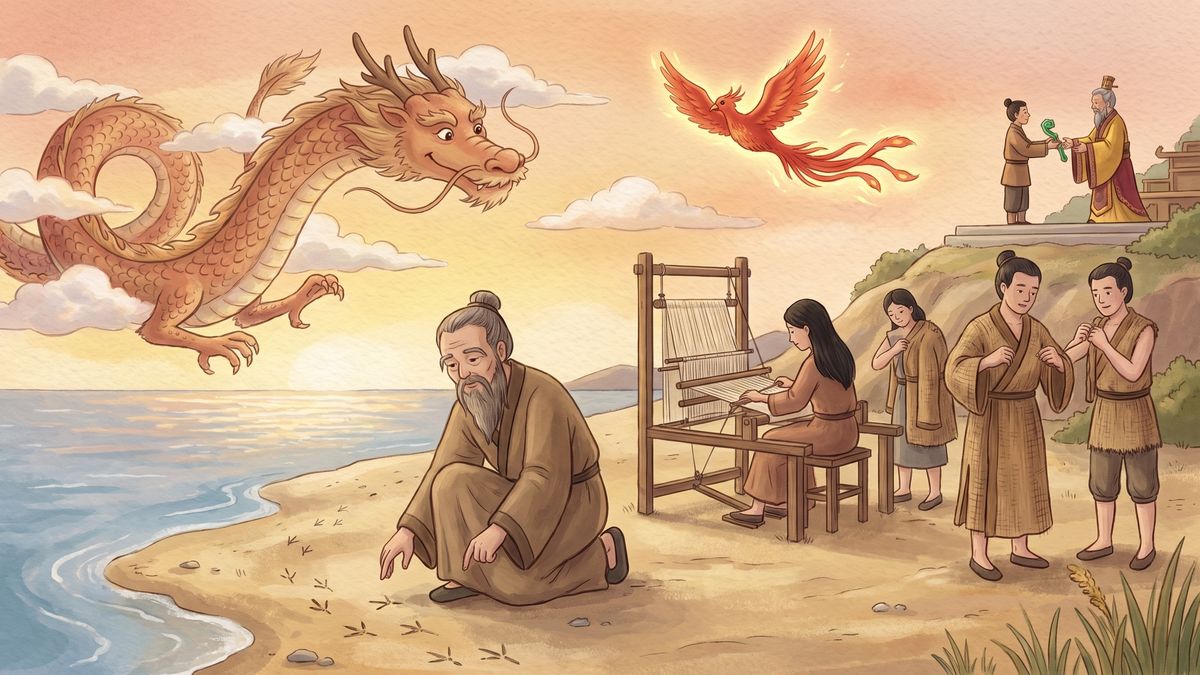
The Dragon Master and the Fire Emperor,
Two rulers of legend: Fuxi, who named his officials after dragons, and Shennong, the Fire Emperor.
the Bird Official and the Human Sovereign:
Shaohao, who named his officials after birds, and the Human Sovereign, one of the Three Sovereigns of legend.
in their time writing was first created
Tradition names Cangjie (仓颉), the scribe of the Yellow Emperor.
and people began to wear clothes.
In this old sense 裳 is read cháng, the skirt-like lower garment. The modern word 衣裳 is yīshang.
Those who gave up the throne and handed over the realm
were Shun of Youyu and Yao of Taotang.
Yao passed the throne to Shun, and Shun to Yu, instead of to their own sons.
Two or three days with this card 练习
- First day: copy and read. Copy each couplet once by hand, slowly, stroke by stroke. Read it aloud with the pinyin: the small strokes under the characters show the melody of the line.
- Second day: recite. Say each couplet two or three times without looking: one line, one breath. If you slip, finish the line, then say it again.
- A third day if you need it. Recite all six lines in one go, then write two of them from memory. Move on when the card sits.
Weave back 温故
Before you start this card, say these again from memory. Look only when you are stuck.
The card before: card 3
- 剑号巨阙The finest sword is named Juque.
- 珠称夜光The finest pearl is called Night-Glow.
- 果珍李柰Of fruits, the plum and the crab-apple are prized.
- 菜重芥姜Of vegetables, mustard and ginger are valued.
- 海咸河淡The sea is salt and the rivers are fresh.
- 鳞潜羽翔Fish dive and birds soar.